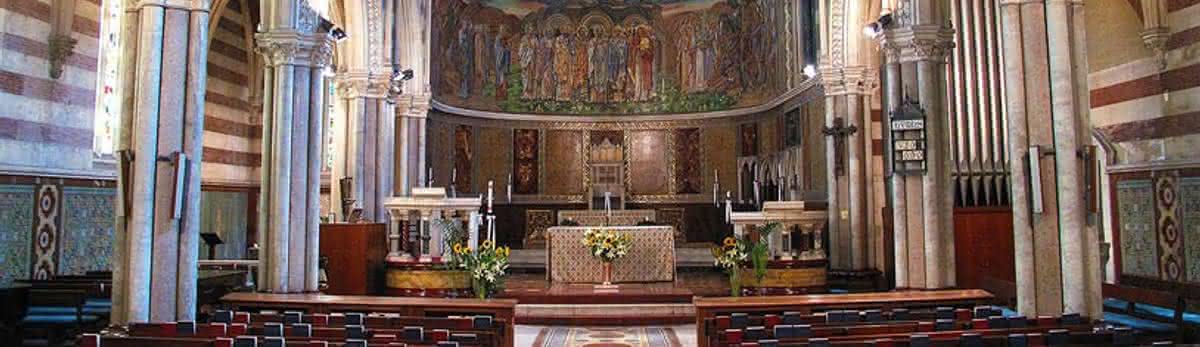
 Saint Paul within the walls Church (Chiesa di S. Paolo entro le Mura)
 Opera in Roma & Orchestra Sinfonica Città di Roma Present: Mozart & Tchaikovsky at St. Paul's Within the Walls (Chiesa di S. Paolo entro le Mura)
Rome, Chiesa di S. Paolo entro le Mura — Sala 1
About the Event
Composed in 1783 in just four days during a stopover in Linz, Symphony No. 36 is a masterpiece of Classical elegance and brilliant spontaneity. It is notable for being Mozart's first symphony to open with a solemn, mysterious Adagio introduction, which quickly gives way to an atmosphere of vibrant energy and melodic fluidity. The work shines through its flawless formal architecture, the balanced dialogue among instruments, and a lively spirit typical of the Enlightenment.
Composed in 1888, Tchaikovsky’s Fifth Symphony is a monumental musical drama centered on the struggle against Fate. This theme is represented by a recurring motif that weaves through all four movements, transforming from initial melancholic darkness into an almost liberating triumph in the finale. Characterized by lush orchestration and the second movement's famous, deeply intense horn solo, the symphony sweeps the listener away with raw, overwhelming emotional power.
Orchestra Sinfonica Città di Roma
A new musical force that is transforming the symphonic scene in Rome.
Born from the desire to meet the growing demand for high‐quality musical experiences, the Città di Roma Symphony Orchestra brings together some of the finest musicians and artists in the capital. Driven by passion and dedication, this ensemble offers a rich, engaging, and ever‐evolving repertoire designed to bring great symphonic music not only to seasoned enthusiasts, but also to younger audiences and newcomers alike.
Practical Information
For reduced categories, it is mandatory to show a valid ID document at the box office.
Program
- Wolfgang Amadeus Mozart – Symphony No. 36 in C major, K. 425
- Peter Ilyich Tchaikovsky – Symphony No. 5 in E minor, op. 64
Cast / Production
Conductors:
Mozart: Rafael Gutierrez, Stefano Borsarelli, Hakob Atyan, Francesco Albarelli
Tchaikovsky: Dominik Steklasa, Andrea Mura, Stephan Smoktunowicz, Federico Fenu
Chiesa di S. Paolo entro le Mura
The 'Church of St. Paul within the Walls' was the first non-Catholic church built in Rome after Italy's unification. The church was built between 1873 and 1880 as an Anglican Basilica in the district of Castro Pretorio, Via Nazionale, Rome. Constructed in the Gothic Revival style, the distinctive external facade is characterised by alternating red and limestone bricks. Four spectacular mosaics by the English pre-Raphaelite Edward Burne-Jones, in collaboration with William Morris, are the crowning glory of the church's interior. The eagle-eyed will spot several famous nineteenth-century figures among those representing the fathers of the church in the elaborate mosaics, among them the artist himself, notable donors and their families, and Abraham Lincoln, Giuseppe Garibaldi and General Grant among the 'Christian Warriors'. Many delightful classical events are hosted in this location, including performances of popular operas like La Traviata.
Giuseppe Verdi
Giuseppe Verdi was an Italian opera composer. From a young age, he developed a musical education with the help of a patron and soon dominated the Italian opera. In fact by his 30s, he became one of the most influential opera composer all over the classical scene. His most famous operas are Il Trovatore, Rigoletto and La Traviata. Furthermore, he was able to establish himself as a landowner with the income from his successful operas and focus on his private life. However, he soon returned to the scene with his new popular work Aida (1871), and three masterpieces: Otello, Requiem and Falstaff.
Giacomo Puccini
Giacomo Puccini was an Italian opera composer of the late 19th century. He was considered one of the greatest composers of the Italian Opera, second only to Verdi. His early works were characterised by features of the traditional 19th century romantic Italian opera. Later, his style developed into the realistic verismo style, which inspired him to write his most famous masterpieces and became one of the leading exponents of the style. His most renowned works La bohème (1896), Tosca (1900), Madama Butterfly (1904), and Turandot (1924), all are popular operas played in the most prestigious venues of the classical world.
Gioachino Rossini
Gioachino Rossini was an Italian composer of the 19th century. He made his debut at the age of 18 and soon became one the most popular opera composer in history. His best known operas are The Barber of Seville (Il barbiere di Siviglia), The Italian Girl in Algiers (L'italiana in Algeri), and Cinderella (La Cenerentola). In general, his style can be defined as song-like melodic which earned him the nickname of "the Italian Mozart”. Later on he became famous for his exciting buildup of orchestral sound over a repeated phrase, which is now known as a "Rossini crescendo”.
Gaetano Donizetti
Gaetano Donizetti was an Italian composer of the early 19th century. He was one of the leading composers of the bel canto opera style along with Gioachino Rossini and Vincenzo Bellini. Over the course of his career, Donizetti wrote almost 70 operas both comic and serious. His first notable success came with a serious opera, Zoraida di Granata, which was presented in 1822 in Rome. As a result, he made a major impact on the Italian and international opera scene and shifted the attention to opera seria (noble and "serious" style operas). However, his best-known works include comedies such as L'elisir d'amore (1832) and Don Pasquale (1843).
Ruggero Leoncavallo
Ruggero Leoncavallo went down in music history as the creator of the opera masterpiece "Pagliacci". Additionally he was known for representing a new artistic style verism whose followers focused on everyday subject matters instead of heroic deeds and legendary characters. He was born in Naples in 1857. When Leoncavallo was 8 he got accepted to the San Pietro a Majella Conservatory, where he studied for eight years. Besides his passion for music, he showed great interest in literature and later studied at the philological department of the University of Bologna. This knowledge helped him later to write librettos for his musical works. In 1879 he tavelled to Egypt to live with his uncle and work as a pianist and teacher at the court of the Egyptian Khedive Tewfil Pasha. However, three years later he was forced to leave the country due to the outbreak of war. He move to France, where he worked as a pianist and songwriter in cafes and music halls. In 1887 he returned to Milan and concentrated on writing operas in the new verismo style. Five years later he finally achieved long-awaited success for his opera Pagliacci. Leoncavallo himself claimed, the plot was based on a real murder trial which his father, a magistrate, reviewed in court when he was a child. It is still considered to be the best operas of the verismo genre and is still frequently performed to this day.
Eduardo Di Capua
Eduardo di Capua was an Italian composer of the late 19th century. His father was a musician and introduced him to the world of music. In fact, he travelled with his father to many European countries. During one of his journeys to the Ukraine in 1898, he composed the famous melody of "O sole mio" together with the poet Giovanni Capurro. O sole mio would become an unofficial, romantic Italian anthem. Funily enough, at the 1920 Olympic Games in Antwerp supposedly the conductor of the band could not find the music for the actual Italian national anthem and instead he played "O Sole Mio."
Address
Chiesa di S. Paolo entro le Mura, Via Nazionale 16a, Rome, Italy — Google Maps
