New Year's Eve Vivaldi on The Strand
London, Kirche St. Mary Le Strand
Über die Veranstaltung
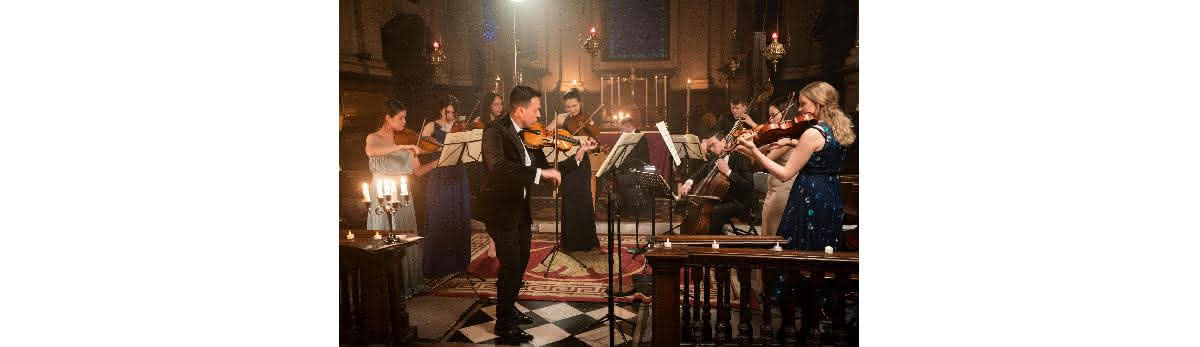
Begrüßen Sie das neue Jahr mit einem unvergesslichen Abend voller barocker Pracht, dargeboten von der gefeierten Piccadilly Sinfonietta zusammen mit einem führenden Gast‐Geigensolisten in der atemberaubenden, von Kerzenlicht erhellten Pracht von St. Mary le Strand – einer der schönsten Kirchen Londons. Das außergewöhnliche Programm umfasst Vivaldis legendäres Meisterwerk „Die vier Jahreszeiten“ sowie weitere beliebte Werke von Händel und Vivaldi. Der Abend wird zudem durch einen Gastauftritt der gefeierten Sopranistin Susan Parkes abgerundet.
„Atemberaubend“ – Classic FM
Es stehen zwei Vorstellungen zur Auswahl: um 17 Uhr und um 21 Uhr
Mit über 200 Auftritten pro Jahr hat sich die Piccadilly Sinfonietta zu einem der beliebtesten klassischen Ensembles Großbritanniens entwickelt, das für seine lebendigen Interpretationen und brillanten Solisten bekannt ist. Lassen Sie die Musik des Barock in fröhlicher Feierlichkeit erklingen, während Sie das neue Jahr inmitten von Kerzenlicht, architektonischer Pracht und musikalischer Weltklasse begrüßen.
Programm
- Georg Friedrich Händel – The Arrival of the Queen of Sheba
- Antonio Vivaldi – Nulla in mundo pax
- Georg Friedrich Händel – Rejoice Greatly
- Antonio Vivaldi – The Four Seasons
Künstler
| Sopran: | Susan Parkes |
|---|---|
| Ensemble: | The Piccadilly Sinfonietta |
Georg Friedrich Händel
An English subject with German origins, Georg Handel was truly a musical pioneer, combining musical traditions of English, Italian and German composers. He was born in 1685 in Halle, Germany, into a very religious and conservative family. His father was dreaming for his son to become a lawyer and would not let young Georg play musical instruments at home. But the Duke Johann Adolf accidentally heard him playing in the chapel and convinced Georg's father to let his son receive a musical education. Thus, Handel became a pupil of the famous organ player and composer Friedrich Zachow. The first success came to Handel in 1705 when he moved to Hamburg and staged his two premiere operas, Almira and Nero, in the Oper am Gänsemarkt. Almira immediately became a highlight of the theatre and was performed around 20 times. Later next year Handel moved to Italy were he received high acclaim and was put on the same level as renowned Italian composers of the time. In 1710 Handel travelled to London where later he decided to settle down. There he wrote a sacred choral piece "Te Deum" that was played in St. Paul´s Cathedral at the ceremony devoted to signing the Utrecht Treaty. From that moment onwards he became the leading composer of England, as the country did not have any native prominent composers. His oeuvre was mainly focused on operas, but by 1730 the genre of Italian opera ceased to be popular and Handel´s success dwindled. During the last years of his life until his death in 1759 he was mainly composing oratorias, including his famous and magnificent Messiah.
Antonio Vivaldi
Antonio Vivaldi went down in history as a creator of the instrumental concert genre and the father of orchestral music. He was born in Venice on the 4th of March 1678. Vivaldi was a weak and sickly child suffering from asthma, however could not stop him from devoting himself completely to music. His father, Giovanni Batista a professional violinist, taught his elder son Antonio to play the violin. With his father young Antonio met the best musicians of Venice of that time and gave concerts in local churches. He also worked as a violin teacher and later as a music director at the orphanage Ospedalle della Pieta. Meanwhile he composed concertos, sacred works and vocal music and in 1713 he achieved great recognition with his sacred choral music. Vivaldi got captivated by the world of opera and worked both as opera composer and impresario at the Teatro San Angelo. In 1717 he obtained a prestigious position by the prince court in Manua as a director of secular music and worked there until around 1720. During that time he composed his world-renowned masterpiece The Four Seasons. In the 1730's his career dwindled as his music became unfashionable and the great composer died in poverty. It took the world two centuries to rediscover and reevaluate Vivaldi’s music, as it was buried into oblivion after his death. In the early 20th century many previously unknown works were found and immediately captured the hearts of the music lovers.
Adresse
Kirche St. Mary Le Strand, Strand, London, Großbritannien — Google Maps