 Spanish Synagogue
 İspanyol Sinagogunda Bolero ve Carmina Burana
Prag, İspanyol Sinagogu — Main Hall
Etkinlik Hakkında
Ravel'in 'Bolero'su, Webber'in 'Evita'sı ve Orff'un 'Carmina Burana'sından alıntıların yanı sıra diğer birçok önemli müzik eserinin yer aldığı bir konserin keyfini çıkarın.
Çek Collegium, bu çeşitli klasik müzik programını Prag'daki İspanyol Sinagogu 'nun harika ortamında gerçekleştirecek.
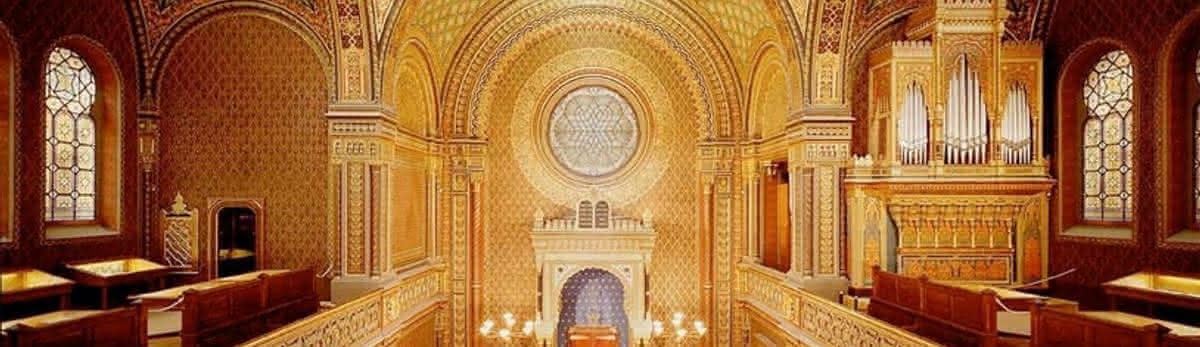
İspanyol Sinagogu, Prag'daki en eski Yahudi binasıdır ve kubbeli tavanı, İslami motifleri ve vitrayları ile çarpıcı altın ve geometrik süslemelere sahiptir.
Spanish Synagogue
Some claim the Spanish Synagogue is the most beautiful synagogue in all of Europe. Unmistakably a highlight of Prague's Jewish Quarter, it was built in 1868 on the site of the oldest synagogue in Prague. Its architectural style – Moorish Revival – inspired by the majestic Alhambra palace in Spain, gives the Synagogue its name. A splendid interior, with stained-glass windows and intricate, colorful arabesque parquet conjures up an exotic atmosphere, and makes the synagogue a very special venue for concerts of classical and sacred music. The Spanish Synagogue is administered by the Jewish Museum, and features permanent exhibitions exploring the history of the Jewish people in Bohemia and Moravia.
Giuseppe Verdi
Giuseppe Verdi was an Italian opera composer. From a young age, he developed a musical education with the help of a patron and soon dominated the Italian opera. In fact by his 30s, he became one of the most influential opera composer all over the classical scene. His most famous operas are Il Trovatore, Rigoletto and La Traviata. Furthermore, he was able to establish himself as a landowner with the income from his successful operas and focus on his private life. However, he soon returned to the scene with his new popular work Aida (1871), and three masterpieces: Otello, Requiem and Falstaff.
Georges Bizet
Georges Bizet devoted his relatively short life of 36 years to the musical theatre. The opera Carmen, pearl of his oeuvre, is still one of the most frequently performed operas in the world. He was born in 1838 into a musically educated family – his father was a singing teacher and his mother a professional piano player. At the age of 4, young George could already read notes and play the piano, and six years later he became enrolled at the Paris Conservatory. After finishing his studies, Bizet won the prestigious Prix de Rome for his cantata Clovis et Clotilde, that allowed him to work solely on his own compositions for five years. He spent four rather carefree years in Italy from 1857 to 1860 where he travelled, composed and developed his talent. After coming back to Paris, he faced struggles and found it very difficult to achieve recognition for his music. In order to make a living, he gave private lessons, composed light entertaining music and made arrangements of piano works by other composers. In fact, he could have easily become a successful pianist as he was a virtuoso piano player and once impressed Franz Liszt himself with the performance of one of Liszt’s piano compositions. But Georges Bizet did not look for a way to make easy money and was adamant about his intention to only compose music. In 1872 he wrote two operas, Djamileh and L’Arlesienne, which were received very coldly but now are considered to be a representation of Bizet’s artistic maturity. Soon before his death in 1875, Carmen premiered in the Opera Comique, but the audience’s verdict was rather negative. Never having witnessed public acclaim during his life, George Bizet now is one of the most famous opera composers in history.
Müşteri Yorumları
4.0 . 5
-
Stefanie S, Schweiz
Mar 2026
Ein wundervoller Ort, ein tolles Ensemble mit sehr gute Sängerin. Jederzeit wieder.
Adres
İspanyol Sinagogu, Vězeňská 141/1, Prag, Çek Cumhuriyeti — Google Haritalar