 (c) Association Classique à tout prix
 Saint Germain des Prés'te Vivaldi'nin 4 Mevsim, Ave Maria ve Ünlü Adagios
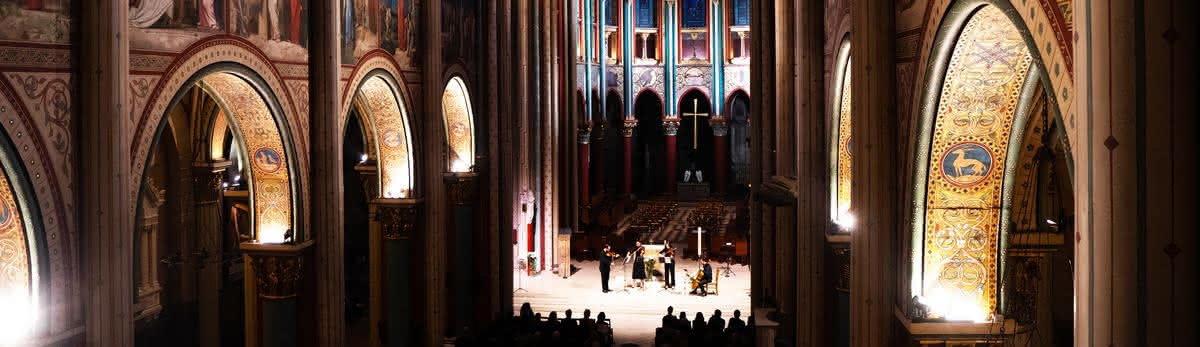
Paris, Saint‐Germain‐des‐Prés Kilisesi — Main Hall
Etkinlik Hakkında
Paris'in saygıdeğer Eglise Saint‐Germain‐des‐Prés kilisesinde düzenlenecek olan merakla beklenen konserde Franz Schubert, Johannes Brahms, Edward Elgar, Georg Friedrich Händel, Johann Sebastian Bach, Antonio Vivaldi, Tomaso Giovanni Albinoni, Frederic Chopin, Nicolò Paganini, Sergei Vasilievich Rachmaninoff, Jules Massenet ve Vittorio Monti gibi bestecilerin klasik müziklerinin büyüsünü yaşayın. Bu dünyaca ünlü mekandan yayılan melodik armonilerin büyüsüne kapılmaya hazır olun.
Antonio Vivaldi'nin en ünlü bestelerinden biri olan Dört Mevsim, 1723 yılında bestelenen dört keman konçertosundan oluşur. Vivaldi'nin en tanınmış eseri haline gelen bu konçerto, dünya çapında en sık icra edilen müzik parçalarından biri olmaya devam etmektedir. Bu konçertoda solist, oda orkestrası eşliğinde virtüözlüğünü sergiler. Konçertonun her bölümü farklı bir mevsimi tasvir eder ve dinleyicilere her birinin benzersiz özünü deneyimleme fırsatı sunar. Örneğin, kış bölümü üst tellerde pizzicato notalarıyla donmuş yağmuru taklit ederken, yaz bölümünün son hareketi gök gürültüsüyle tamamlanan bir fırtınayı çağrıştırır.
2014 yılında kurulan Hélios orkestrası, dinamik ve eklektik yapısıyla müzik sahnesinde silinmez bir iz bırakmaktadır. Sanat yönetmeni Paul Savalle'nin rehberliğinde orkestra, orkestra pratiği yoluyla genç müzisyenlerin profesyonel entegrasyonuna önem vermektedir. Bu, genç mezunların deneyimli orkestra müzisyenleri, şefler ve solistlerle işbirliği yapabilecekleri optimal bir ortam yaratmaktadır.
Barok müziğinden çağdaş müziğe kadar uzanan bir repertuara sahip olan orkestra, hem senfonik hem de koro eserlerini kapsayan çeşitli programlar sunmaktadır. Bölüm ve bölge korolarıyla işbirliği yapan topluluk, farklı müzik unsurları arasındaki simbiyotik ilişkiyi sergileyen büyüleyici performanslar yaratır. Farklı şeflerle çalışmak, müzisyenlerin çeşitli repertuarları keşfetmelerini ve yorumlama paletlerini genişletmelerini sağlar. Bu yetenekli müzisyenlerin çoğu, Fransa'nın önde gelen konservatuarlarından mezun olup, bazıları ulusal orkestraların üyesidir.
Farklı izleyicilere ve mekanlara uyum sağlayan Hélios orkestrası, kompozisyonunu değiştirerek erişimini sürekli genişletmektedir. Yaylı çalgılar dörtlüsü, senfoni orkestrası veya nefesli çalgılar topluluğu olarak performans sergileyen orkestra, Paris'in en prestijli kiliselerinde izleyicileri büyülemekte ve şehrin zengin mimari mirasını keşfetmek için eşsiz bir fırsat sunmaktadır. Orkestranın değişken geometrili yapısı, müzisyenlerin tutkulu bir merakla çok çeşitli müzik türlerini ele almalarını sağlayarak herkese unutulmaz bir deneyim yaşatmaktadır.
Program
Vivaldi'nin Dört Mevsim: Yaz ve Kış
Handel'in "Sarabande"
Massenet'in "Thaïs'den Meditasyon"
Bach'ın "Aria"
Schubert'in "Ave Maria"
Rachmaninoff'un "Vocalise"
Albinoni'nin "G Minör Adagio"
Brahms'ın "Macar Dansı No. 5"
Paganini'nin "Andante Cantabile"
Chopin'in "Nocturne"
Elgar'ın "Salut d'Amour"
Monti'nin "Czardas"
Program
- Franz Schubert – Ave Maria
- Antonio Vivaldi – Winter and Summer from The Four Seasons
Sanatçılar
| Orkestra: | Orchestre Helios Established with the aim of forging links between graduating students and professional orchestras, the Orchestre Hélios has gone from strength to strength in the ten years since its 2014 launch. The brainchild of artistic director, Paul Savalle, the orchestra is unusual in its commitment to collaborating with local and regional choral ensembles, expanding its repertoire, which already stretches from the Baroque to the Contemporary, to include major vocal works. The orchestra's musicians are graduates and senior students at France's leading conservatoires, and several also play with national orchestras. A roster of distinguished guest conductors helps accustom members to different styles and approaches to musical leadership. Performing in some of Paris' most majestic churches, including La Madeleine and Saint Sulpice, on a regular basis, the orchestra is designed in such a way that its forces can scale from full symphony down to string quartet, facilitating access to additional beautiful and unusual spaces, many of which are not usually open to the public. |
|---|---|
| Keman: | Glen Rouxel Genç Fransız kemancı, canlı ve güçlü yorumlarıyla prestijli 'Prix d'Europe' ödülünün birincilik ödülünü kazandı. Avrupa'da solist olarak büyük rağbet gören sanatçı, aynı zamanda Les Détours Métaphoniques (Aveyron) festivalinin müzik direktörüdür. Rouxel, Fransa'nın en iyi orkestralarının düzenli konuğu ve uluslararası alanda da giderek daha fazla talep görüyor. Paris Filarmoni ve Moskova'daki Çaykovski Salonu gibi prestijli mekanlarda solist olarak sahne aldı. |
Eglise Saint-Germain-des-Prés
The oldest Romanesque church in Paris,Saint-Germain-des-Prés was founded in the 6th century as an abbey. The church underwent periodic reconstructions, made necessary by 9th century Norman raids, and Revolutionary era fires, until the 19th century. However, the Romanesque lines of the early interior are still recognizable beneath the paint of 19th-century frescoes. The name of the church was also given to its quarter (Saint-Germain-des-Prés Quarter), a vibrant area in Paris’ 6th district, traditionally popular among writers and intellectuals, and the home of Sartre and de Beauvoir's existentialist movement.
Franz Schubert
During his rather short life, Franz Schubert, one of the fathers of romanticism in music, had always been an unappreciated genius who had never received public acclaim. Only his family and friends were delighted by his music, and most of his works were discovered and published only many years after his death. Franz Schubert was born on the 31th of March 1797 in the suburbs of Vienna. His father and eldest brother were amateur musicians and they taught him to play piano and violin. At the age of 11 Schubert was a singer in a choir at the Lichtenthal parish and later auditioned for Antonio Salieri and admitted to the emperor’s choir. During that period young Franz started composing his own works. However, after his voice broke he had to leave the choir and in 1814 he started working as a teacher in the same parish school as his father. He never stopped composing and 4 years later he decided to quit teaching and devote his life completely to music. He fell out with his father because of that and struggled to make ends meet. In 1818 Schubert went to Vienna, where he met Vogl. Together they gave private concerts in small aristocratic circles, mainly playing Lieder, which Schubert wrote around 600. Franz Schubert gave only one big public concert in his whole life in March 1828, which was very warmly received by the audience. However, his health was deteriorating and in November the same year he died of thyroid fever at the age of 31.
Georg Friedrich Händel
An English subject with German origins, Georg Handel was truly a musical pioneer, combining musical traditions of English, Italian and German composers. He was born in 1685 in Halle, Germany, into a very religious and conservative family. His father was dreaming for his son to become a lawyer and would not let young Georg play musical instruments at home. But the Duke Johann Adolf accidentally heard him playing in the chapel and convinced Georg's father to let his son receive a musical education. Thus, Handel became a pupil of the famous organ player and composer Friedrich Zachow. The first success came to Handel in 1705 when he moved to Hamburg and staged his two premiere operas, Almira and Nero, in the Oper am Gänsemarkt. Almira immediately became a highlight of the theatre and was performed around 20 times. Later next year Handel moved to Italy were he received high acclaim and was put on the same level as renowned Italian composers of the time. In 1710 Handel travelled to London where later he decided to settle down. There he wrote a sacred choral piece "Te Deum" that was played in St. Paul´s Cathedral at the ceremony devoted to signing the Utrecht Treaty. From that moment onwards he became the leading composer of England, as the country did not have any native prominent composers. His oeuvre was mainly focused on operas, but by 1730 the genre of Italian opera ceased to be popular and Handel´s success dwindled. During the last years of his life until his death in 1759 he was mainly composing oratorias, including his famous and magnificent Messiah.
Johann Sebastian Bach
The name Bach and the word musician had long been synonyms in Germany as the world saw 56 musicians from this kin. But it was Johann Sebastian Bach, a genius composer and virtuoso organ player, who shed lustre on his family name. He was born on th 31st of March 1685 in Eisenach, a small town in Thuringia. At the age of 10 he became an orphan and was brought up by his elder brother Johann Christoph, who was an organist in a neighbouring town. His brother was the one to teach music to the young Johann Sebastian. Later he moved to Luneburg where he attended a church school and mastered the techniques of playing violin, viola, piano and organ by the age of 17. Besides that, Bach was a choir singer and later after his voice broke he became a chanter’s assistant. In 1703 Bach was hired as a court musician in the chapel of Duke Johann Ernst III. He earned such a good reputation there that he was later invited to Arnstadt to be an organist at the New Church, where he wrote his best organ works. In 1723 he moved to Leipzig to be a chantor at St. Thomas Church where he stayed until his death of a stroke in 1750. In the year of his death he had undergone unsuccessful eye surgery which lead him to lose his eyesight. During that strenuous time his second wife Anna Magdalena helped him to write his last musical pieces. Bach’s artistic legacy is vast. He created compositions in all genres of the time: oratorias, cantatas, masses, motets, music for organ, piano and violin.
Antonio Vivaldi
Antonio Vivaldi went down in history as a creator of the instrumental concert genre and the father of orchestral music. He was born in Venice on the 4th of March 1678. Vivaldi was a weak and sickly child suffering from asthma, however could not stop him from devoting himself completely to music. His father, Giovanni Batista a professional violinist, taught his elder son Antonio to play the violin. With his father young Antonio met the best musicians of Venice of that time and gave concerts in local churches. He also worked as a violin teacher and later as a music director at the orphanage Ospedalle della Pieta. Meanwhile he composed concertos, sacred works and vocal music and in 1713 he achieved great recognition with his sacred choral music. Vivaldi got captivated by the world of opera and worked both as opera composer and impresario at the Teatro San Angelo. In 1717 he obtained a prestigious position by the prince court in Manua as a director of secular music and worked there until around 1720. During that time he composed his world-renowned masterpiece The Four Seasons. In the 1730's his career dwindled as his music became unfashionable and the great composer died in poverty. It took the world two centuries to rediscover and reevaluate Vivaldi’s music, as it was buried into oblivion after his death. In the early 20th century many previously unknown works were found and immediately captured the hearts of the music lovers.
Tomaso Giovanni Albinoni
Tomaso Giovanni Albinoni was an Italian Baroque composer of the early 18th century. He is well known as one of the greatest composers of instrumental music, especially known for his concertos. "Adagio in G minor" was supposedly written by him. His fascinating instrumental music attracted attention from different figures of the Classical scene, such as Johann Sebastian Bach who wrote at least two fugues on Albinoni's themes.
Frederic Chopin
Frederic Chopin was a Polish composer and pianist of the Romantic area (early 19th century). He wrote primarily piano solos but also piano concerts, chamber pieces and songs set to Polish lyrics. He is well-known as a poetic genius without competition of his generation. In fact, he created the concept of instrumental ballade and his performances were noted for their sensitivity and fine distinction. He spent most of his life in Paris, where he performed for the intimate atmospheres of salons. For most of his life, he suffered poor health. As a result, he died quite young at the age of 39, probably of tuberculosis.
Jules Massenet
Jules Massenet was a French composer of the late 19th century. He influenced the Romantic era with his works of operas such as Manon (1884) and Werther (1892). However, he also composed other genres such as ballets, oratorios, orchestral works and piano pieces. In 1863r he won the top musical prize, the Prix de Rome, and became one of the leading composer of opera in France. later on in life he became a professor at the Conservatoire of Paris, like many prominent French composers of the period.
Müşteri Yorumları
4.8 . 5
-
FLORENT M, France
Mar 2026
Magnifiques interprétations ! Des musiciens très talentueux !
-
Eugene P, USA
Mar 2026
Much more musically fulfilling than we could have imagined.
-
William A, United Kingdom
Mar 2026
I have to say that they were delightfully enthusiastic, and gave a bravura performance. Earlier in the concert there was some quiet, beautiful playing, and I would have enjoyed more of this!
-
Camille S, France
Şub 2026
Beautiful space and gorgeous performance. Thoroughly enjoyed the pieces picked by the artists and how they were interpreted.
Adres
Saint‐Germain‐des‐Prés Kilisesi, 3, place Saint‐Germain‐des‐Prés, Paris, Fransa — Google Haritalar