 Kaiser-Wilhelm Memorial Church, Berlin
 베를린 오케스트라: 카이저 빌헬름 기념 교회에서의 비발디, 바흐, 모차르트
베를린, 카이저 빌헬름 게데슈타트 교회
공연 정보
베를린 오케스트라가 선사하는 유럽 클래식 음악 300년의 위대한 걸작들과 함께 카이저 빌헬름 기념 교회에서 펼쳐지는 저녁을 경험하세요.
두앙가모른 푸
강력하고 표현력 풍부한 소프라노로 찬사를 받는 두앙가모른 푸는 전 세계 관객의 주목을 받고 있습니다. 태국 출신인 그녀는 빈과 베를린에서의 수학으로 재능을 갈고닦았습니다. 2022년 오페라 데뷔 무대에서 그녀는 빈 쇤브룬의 슈로스 극장에서 그레텔 역으로 관객을 사로잡았다. 오사카, 아스타나, 브뤼셀, 그라츠, 빈 등 여러 유명 국제 콩쿠르에서 입상한 두앙가모른의 재능은 꾸준히 인정받아 왔다. 2024년에는 베를린 필하모니 데뷔 콘서트의 절대 우승자로 선정되는 영예를 안으며 오페라계의 떠오르는 스타로서 입지를 굳혔다.
두앙아모른 푸의 목소리가 선사하는 웅장한 아름다움과 강렬함을 경험할 기회를 놓치지 마십시오. 그녀가 무대에 오르는 콘서트는 오래도록 기억에 남을 감동을 선사할 것입니다.
유대윤 — 바이올린 독주
바이올리니스트 유대윤은 2021년 뮌헨 ARD 국제 음악 콩쿠르에서 '특별상'을 수상하며 국제적인 명성을 얻었습니다. 또한 2024년 엘리자베스 여왕 국제 바이올린 콩쿠르 입상자이며, 2023년 롱-티보 콩쿠르에서 2등을 차지했습니다. 유대윤은 벨기에 국립 오케스트라, 한국 국립 교향악단 등 유명 오케스트라와 협연했다. 금호문화재단의 후원으로 1774년산 요한네스 바티스타 과다니니 바이올린을 사용하고 있다.
알렉산드르 볼코프 — 오르간
2003년 글라조프 시 출생의 오르가니스트 알렉산드르 볼코프는 상트페테르부르크 M.I. 글린카 합창학교에서 오르간, 피아노, 성악, 지휘를 전공하며 우등 졸업했다. 이후 베를린 예술대학에 진학하여 2022년부터 오르간을 전공하고 있다. 젊은 나이에도 불구하고 알렉산더는 이미 여러 오르간 콩쿠르와 페스티벌에서 수상 경력을 쌓았으며, 2021년 사라토프에서 열린 "제2회 전러시아 청소년 오르가니스트 콩쿠르"와 모스크바의 "2021 비바트 무지카" 콩쿠르에서 상을 받았다. 알렉산더의 탁월한 기교와 감성적인 해석은 러시아, 슬로베니아, 핀란드, 독일의 대성당과 콘서트홀에서 관객들을 사로잡았다.
베를린 오케스트라
베를린 오케스트라는 역동적인 연주와 풍부하고 표현력 있는 음색으로 유명한 세계적 현악 앙상블로, 각계각층의 저명한 음악가들로 구성되어 있습니다. 이번 공연에서 오케스트라는 300년에 걸친 음악사의 걸작들을 선보입니다.
프로그램
- 요한 파헬벨 – Canon – Canon & Gigue
- 프란츠 슈베르트 – Ave Maria (Op. 52)
- 볼프강 아마데우스 모차르트 – Requiem Lacrimosa
- 볼프강 아마데우스 모차르트 – Salzburg Symphony K. 136 Allegro
- 요한 세바스티안 바흐 – Toccata und Fuge d‐Moll BWV 565
- 조지 프리드리히 헨델 – Largo aus Xerxes
- 안토니오 비발디 – Frühling & Sommer
- 샤를-마리 장 알베르 위도르 – Toccata from Symphony No. 5
- 루트비히 판 베토벤 – Symphonie Nr. 5, Allegro con brio
아티스트
| 오케스트라: | 베를린 오케스트라 세계 각지에서 모인 뛰어난 젊은 예술가들로 구성된 이 베를린 기반의 실내악단은 도시의 유명한 카이저 빌헬름 기념 교회에서 정기적으로 공연을 펼치고 있습니다. 교회 내부의 화려한 스테인드글라스 창문이 만들어내는 감동적인 분위기 속에서, 그들은 바흐부터 베토벤에 이르는 위대한 클래식 작품들을 연주하며, 유망한 경력의 초기 단계에 있는 솔로 연주자들과 함께 무대를 빛냅니다. 베를린 오케스트라는 클래식 음악이 장르의 경계를 넘어서는 힘을 믿으며, 독일의 DJ이자 댄스 음악 프로듀서인 알렉스 크리스텐센과의 장기적인 협업을 통해 독일 전역과 해외에서 팬들을 매료시키는 투어를 진행해오고 있습니다. |
|---|---|
| 소프라노: | Duangamorn Fu |
| 바이올린: | Dayoon You |
| 오르간 연주자: | Aleksandr Volkov |
Kaiser-Wilhelm-Gedächtniskirche
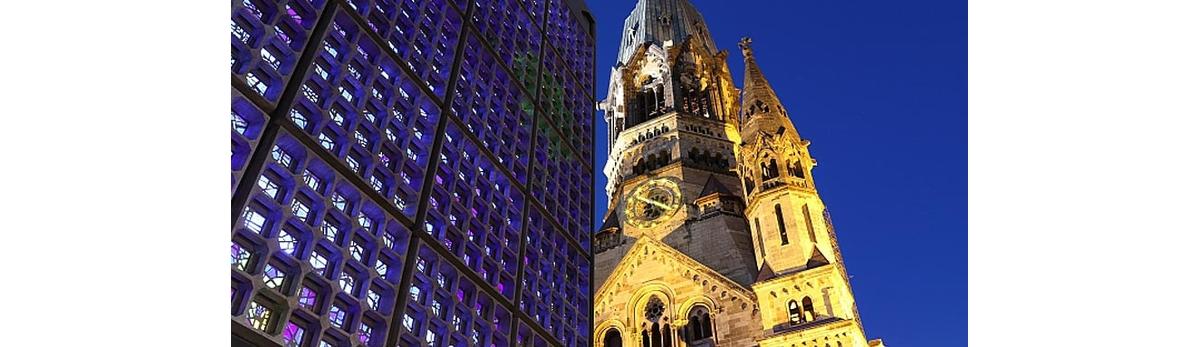
The Kaiser Wilhelm Memorial Church is a Protestant church affiliated with the regional congregation of the German Evangelical church. Located in Berlin on the famous Kurfurstendamm ,the remaining spire of the old church, damaged in World War II is a well-known landmark of West Berlin, nicknamed the 'Hollow Tooth' by Berliners. The current church, and chapel tower, built in the early 1960s, are sometimes called 'the lipstick and the powder compact' for their respective shapes, and are notable for their extensive use of stained glass. The damaged remnants of the 1890s church were not lost, but have been collected into a memorial hall on the ground floor of the church as a reminder of past events.
Wolfgang Amadeus Mozart
Perhaps the most important composer of all time, Wolfgang Amadeus Mozart was an Austrian composer of the late 18th century. Born in 1756 in Salzburg, he showed prodigious musical talent from childhood. Beginning at five years of age, he composed more than 600 works, including concertos, symphonies, religious works and operas before his premature death at the age of 35. Hi influence over successive generations cannot be overestated - Ludwig van Beethoven wrote of Mozart "posterity will not see such a talent again in 100 years”. Despite the immense success of his compositions, and the acclaim he received across Europe, Mozart achieved little financial security and rwas buried in an unmarked grave in Vienna's St Marx Cemetery.
Franz Schubert
During his rather short life, Franz Schubert, one of the fathers of romanticism in music, had always been an unappreciated genius who had never received public acclaim. Only his family and friends were delighted by his music, and most of his works were discovered and published only many years after his death. Franz Schubert was born on the 31th of March 1797 in the suburbs of Vienna. His father and eldest brother were amateur musicians and they taught him to play piano and violin. At the age of 11 Schubert was a singer in a choir at the Lichtenthal parish and later auditioned for Antonio Salieri and admitted to the emperor’s choir. During that period young Franz started composing his own works. However, after his voice broke he had to leave the choir and in 1814 he started working as a teacher in the same parish school as his father. He never stopped composing and 4 years later he decided to quit teaching and devote his life completely to music. He fell out with his father because of that and struggled to make ends meet. In 1818 Schubert went to Vienna, where he met Vogl. Together they gave private concerts in small aristocratic circles, mainly playing Lieder, which Schubert wrote around 600. Franz Schubert gave only one big public concert in his whole life in March 1828, which was very warmly received by the audience. However, his health was deteriorating and in November the same year he died of thyroid fever at the age of 31.
Ludwig van Beethoven
Ludwig van Beethoven was a German pianist and composer of the late 18th century. He is well known as the most influential composers of all time as well as crucial figure to the Classical music scene. In fact, he demonstrated his musical talent at an early age, taking lessons from his father and composer/conductor Christian Gottlob Neefe. Later, he moved to Vienna where he gained the reputation of a virtuoso pianist by composing his popular masterpieces. He created his most admired works in his last 15 years of life, all the while being almost completely deaf.
Georg Friedrich Händel
An English subject with German origins, Georg Handel was truly a musical pioneer, combining musical traditions of English, Italian and German composers. He was born in 1685 in Halle, Germany, into a very religious and conservative family. His father was dreaming for his son to become a lawyer and would not let young Georg play musical instruments at home. But the Duke Johann Adolf accidentally heard him playing in the chapel and convinced Georg's father to let his son receive a musical education. Thus, Handel became a pupil of the famous organ player and composer Friedrich Zachow. The first success came to Handel in 1705 when he moved to Hamburg and staged his two premiere operas, Almira and Nero, in the Oper am Gänsemarkt. Almira immediately became a highlight of the theatre and was performed around 20 times. Later next year Handel moved to Italy were he received high acclaim and was put on the same level as renowned Italian composers of the time. In 1710 Handel travelled to London where later he decided to settle down. There he wrote a sacred choral piece "Te Deum" that was played in St. Paul´s Cathedral at the ceremony devoted to signing the Utrecht Treaty. From that moment onwards he became the leading composer of England, as the country did not have any native prominent composers. His oeuvre was mainly focused on operas, but by 1730 the genre of Italian opera ceased to be popular and Handel´s success dwindled. During the last years of his life until his death in 1759 he was mainly composing oratorias, including his famous and magnificent Messiah.
Johann Sebastian Bach
The name Bach and the word musician had long been synonyms in Germany as the world saw 56 musicians from this kin. But it was Johann Sebastian Bach, a genius composer and virtuoso organ player, who shed lustre on his family name. He was born on th 31st of March 1685 in Eisenach, a small town in Thuringia. At the age of 10 he became an orphan and was brought up by his elder brother Johann Christoph, who was an organist in a neighbouring town. His brother was the one to teach music to the young Johann Sebastian. Later he moved to Luneburg where he attended a church school and mastered the techniques of playing violin, viola, piano and organ by the age of 17. Besides that, Bach was a choir singer and later after his voice broke he became a chanter’s assistant. In 1703 Bach was hired as a court musician in the chapel of Duke Johann Ernst III. He earned such a good reputation there that he was later invited to Arnstadt to be an organist at the New Church, where he wrote his best organ works. In 1723 he moved to Leipzig to be a chantor at St. Thomas Church where he stayed until his death of a stroke in 1750. In the year of his death he had undergone unsuccessful eye surgery which lead him to lose his eyesight. During that strenuous time his second wife Anna Magdalena helped him to write his last musical pieces. Bach’s artistic legacy is vast. He created compositions in all genres of the time: oratorias, cantatas, masses, motets, music for organ, piano and violin.
Antonio Vivaldi
Antonio Vivaldi went down in history as a creator of the instrumental concert genre and the father of orchestral music. He was born in Venice on the 4th of March 1678. Vivaldi was a weak and sickly child suffering from asthma, however could not stop him from devoting himself completely to music. His father, Giovanni Batista a professional violinist, taught his elder son Antonio to play the violin. With his father young Antonio met the best musicians of Venice of that time and gave concerts in local churches. He also worked as a violin teacher and later as a music director at the orphanage Ospedalle della Pieta. Meanwhile he composed concertos, sacred works and vocal music and in 1713 he achieved great recognition with his sacred choral music. Vivaldi got captivated by the world of opera and worked both as opera composer and impresario at the Teatro San Angelo. In 1717 he obtained a prestigious position by the prince court in Manua as a director of secular music and worked there until around 1720. During that time he composed his world-renowned masterpiece The Four Seasons. In the 1730's his career dwindled as his music became unfashionable and the great composer died in poverty. It took the world two centuries to rediscover and reevaluate Vivaldi’s music, as it was buried into oblivion after his death. In the early 20th century many previously unknown works were found and immediately captured the hearts of the music lovers.
주소
카이저 빌헬름 게데슈타트 교회, Breitscheidtplatz, 베를린, 독일 — Google 지도