Exkluzív Vivaldi‐koncert: „A négy évszak” a Pantheon közelében – Egy este a kortalan elegancia jegyében!
Róma, Szent Ivo a Bölcsességhez — Main
Az eseményről
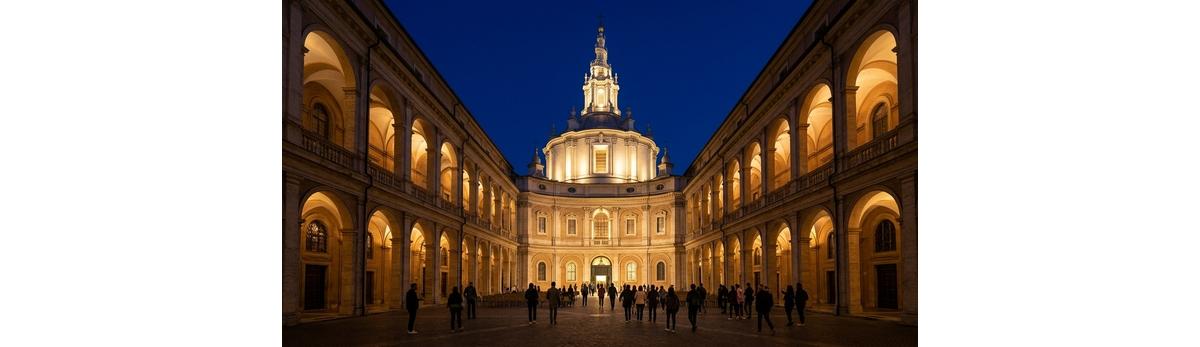
A Pantheon és a Piazza Navona között, az olasz történelem és művészet szívében élvezheti Vivaldi remekművét vonósötös feldolgozásban egy monumentális barokk gyöngyszem belsejében: a Sant’Ivo alla Sapienza‐templom és reneszánsz udvarának tekintélyes környezetében.
Az 1642 és 1660 között épült, a zseniális Francesco Borromini által tervezett Sant’Ivo alla Sapienza‐templom a titkos Róma barokk remekműve, kivételes akusztikával és az isteni bölcsességet szimbolizáló geometriával: egyedülálló csillag alakú alaprajzzal, a híres spirál alakú, dugóhúzószerű lámpával, amelynek csúcsán lángoló korona és kovácsoltvas galamb található.
Program
- Antonio Vivaldi – The Four Seasons Op. 8
Művészek
| Ensemble: | International Strings Ensemble |
|---|
Sant’Agnese in Agone
Sant'Agnese in Agone is an Italian Baroque church built during the 17th-century in Rome. It faces onto the Piazza Navona, one of the most important squares in the Italian capital's histroical centre, and the location of the former Stadium of Domitian, in which the early christian Saint Agnes was martyred. The crypt, or sacellum infimum, is the only remnant of the ancient church that marked the precise spot where the Saint met her grisly end. Piazza Navona also hosts other great works of art such as Bernini's Fountain of the Four Rivers, situated in front of Sant'Agnese in Agone. There are many urban legends that refer to the sculpted figure of the 'Nile' by Bernini and the facade of the church, designed by his rival, Borromini. It is said that Bernini depicted 'Father Nile' covering his eyes in fear that the church in front of him would disintegrate. The story persists because of the bitter rivalry known to have existed between the two artists, despite the fact that the Bernini's fountain was built some years before the church was constructed.
Antonio Vivaldi
Antonio Vivaldi went down in history as a creator of the instrumental concert genre and the father of orchestral music. He was born in Venice on the 4th of March 1678. Vivaldi was a weak and sickly child suffering from asthma, however could not stop him from devoting himself completely to music. His father, Giovanni Batista a professional violinist, taught his elder son Antonio to play the violin. With his father young Antonio met the best musicians of Venice of that time and gave concerts in local churches. He also worked as a violin teacher and later as a music director at the orphanage Ospedalle della Pieta. Meanwhile he composed concertos, sacred works and vocal music and in 1713 he achieved great recognition with his sacred choral music. Vivaldi got captivated by the world of opera and worked both as opera composer and impresario at the Teatro San Angelo. In 1717 he obtained a prestigious position by the prince court in Manua as a director of secular music and worked there until around 1720. During that time he composed his world-renowned masterpiece The Four Seasons. In the 1730's his career dwindled as his music became unfashionable and the great composer died in poverty. It took the world two centuries to rediscover and reevaluate Vivaldi’s music, as it was buried into oblivion after his death. In the early 20th century many previously unknown works were found and immediately captured the hearts of the music lovers.
Cím
Szent Ivo a Bölcsességhez, Corso del Rinascimento, 40, Róma, Olaszország — Google Térkép
