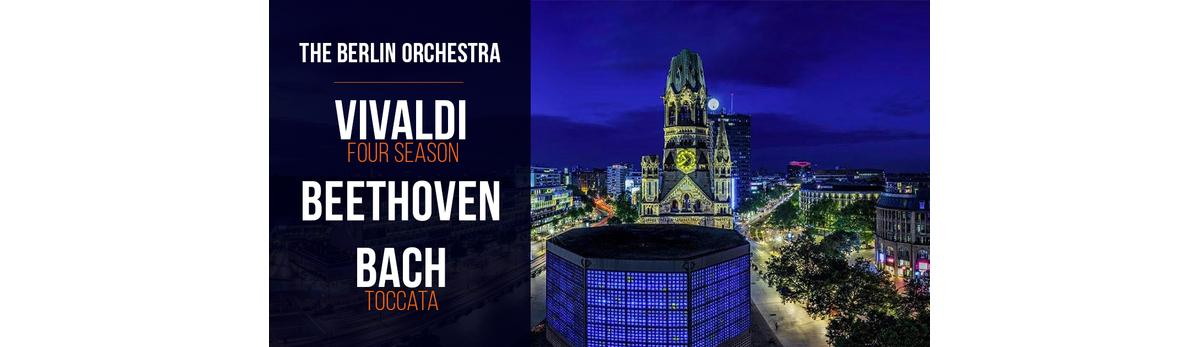
The Berlin Orchestra újévi koncertje: Kaiser‐Wilhelm‐emléktemplom
Berlin, Kaiser‐Wilhelm‐Gedächtniskirche
Az eseményről
Töltsön el egy estét Európa 300 éves legkiválóbb klasszikus remekműveinek világában, melyeket az „ the Berlin Orchestra ” együttes ad elő a csodálatos Kaiser‐Wilhelm‐emléktemplomban.
Duangamorn Fu
Erőteljes, kifejező szopránjával híressé vált Duangamorn Fu világszerte elvarázsolta a közönséget. Thaiföldről származó énekesnő Bécsben és Berlinben fejlesztette tehetségét. 2022‐ben debütált az operaszínpadon Gretel szerepében a bécsi Schönbrunni Kastélyszínházban. Duangamorn számos nemzetközi versenyen nyert díjat Oszakában, Asztanában, Brüsszelben, Grazban és Bécsben, így széles körű elismertségre tett szert. 2024‐ben elnyerte a berlini Filharmónia debütáló koncertjét, megerősítve ezzel ígéretes pályafutását feltörekvő operaénekesként.Tapasztalja meg Duangamorn Fu hangjának szárnyaló szépségét és intenzitását egy olyan koncerten, amely biztosan maradandó benyomást fog hagyni.
Dayoon You – hegedűszólista
Dayoon You hegedűművész a 2021‐es müncheni ARD Nemzetközi Zenei Versenyen elnyert „Különdíj” után vált nemzetközi hírűvé. A 2024‐es Erzsébet királynő Hegedűverseny díjazottja, és a 2023‐as Long‐Thibaud Hegedűversenyen második helyezést ért el. Dayoon You fellépett már a Belga Nemzeti Zenekarral, a Koreai Nemzeti Szimfonikus Zenekarral és más vezető együttesekkel is. Egy 1774‐es Joannes Baptista Guadagnini hegedűn játszik, amelyet a Kumho Kulturális Alapítvány nagylelkűen kölcsönzött neki.The Berlin Orchestra
The Berlin Orchestra A [zenekar neve] a világ minden tájáról érkező vezető zenészekből álló, elismert vonósegyüttes, amelyet dinamikus előadásairól és gazdag, kifejező hangzásáról dicsérnek. Koncertjein a zene történetének 300 évét átívelő remekműveket mutat be.Program
- Johann Pachelbel – Canon – Canon & Gigue
- Wolfgang Amadeus Mozart – Salzburger Symphonie KV 136
- Georg Friedrich Händel – Largo aus Xerxes
- Antonio Vivaldi – Die vier Jahreszeiten (Frühling & Winter)
- Georg Friedrich Händel – Aus dem Messias (He Shall Feed His Flock)
- Charles‐Marie Jean Albert Widor – Toccata aus Symphonie Nr. 5 ( Orgel )
- John Francis Wade – Adeste Fideles
- Johann Sebastian Bach – Festive Präludium & Fugue BWV 552 (Prelude and Fugue in E‐flat Major from Part III of the Clavier-Übung)
- Franz Schubert – Ave Maria
Művészek
| Zenekar: | A Berlini Zenekar A világ minden tájáról származó kivételes tehetségű fiatal művészekből álló berlini székhelyű kamarazenekar rendszeresen fellép a város híres Kaiser‐Wilhelm‐Gedächtnis‐Kirche templomában. A templom hatalmas ólomüveg ablakai által teremtett hangulatos környezetben Bach‐tól Beethoven‐ig terjedő klasszikus művekből álló programot adnak elő, amelyben tehetséges, pályájuk elején járó szólisták is közreműködnek. A Berlin Orchestra hiszi, hogy a klasszikus zene képes túllépni a műfaji határokon – ezért régóta együttműködnek a német DJ‐vel és dance zenei producerrel, Alex Christensen‐nel, akivel együtt turnéznak Németországban és külföldön, hogy örömet szerezzenek rajongóiknak. |
|---|---|
| Szoprán: | Duangamorn Fu |
| Hegedű: | Dayoon You |
| Orgonista: | Aleksandr Volkov |
Kaiser-Wilhelm-Gedächtniskirche
The Kaiser Wilhelm Memorial Church is a Protestant church affiliated with the regional congregation of the German Evangelical church. Located in Berlin on the famous Kurfurstendamm ,the remaining spire of the old church, damaged in World War II is a well-known landmark of West Berlin, nicknamed the 'Hollow Tooth' by Berliners. The current church, and chapel tower, built in the early 1960s, are sometimes called 'the lipstick and the powder compact' for their respective shapes, and are notable for their extensive use of stained glass. The damaged remnants of the 1890s church were not lost, but have been collected into a memorial hall on the ground floor of the church as a reminder of past events.
Wolfgang Amadeus Mozart
Perhaps the most important composer of all time, Wolfgang Amadeus Mozart was an Austrian composer of the late 18th century. Born in 1756 in Salzburg, he showed prodigious musical talent from childhood. Beginning at five years of age, he composed more than 600 works, including concertos, symphonies, religious works and operas before his premature death at the age of 35. Hi influence over successive generations cannot be overestated - Ludwig van Beethoven wrote of Mozart "posterity will not see such a talent again in 100 years”. Despite the immense success of his compositions, and the acclaim he received across Europe, Mozart achieved little financial security and rwas buried in an unmarked grave in Vienna's St Marx Cemetery.
Franz Schubert
During his rather short life, Franz Schubert, one of the fathers of romanticism in music, had always been an unappreciated genius who had never received public acclaim. Only his family and friends were delighted by his music, and most of his works were discovered and published only many years after his death. Franz Schubert was born on the 31th of March 1797 in the suburbs of Vienna. His father and eldest brother were amateur musicians and they taught him to play piano and violin. At the age of 11 Schubert was a singer in a choir at the Lichtenthal parish and later auditioned for Antonio Salieri and admitted to the emperor’s choir. During that period young Franz started composing his own works. However, after his voice broke he had to leave the choir and in 1814 he started working as a teacher in the same parish school as his father. He never stopped composing and 4 years later he decided to quit teaching and devote his life completely to music. He fell out with his father because of that and struggled to make ends meet. In 1818 Schubert went to Vienna, where he met Vogl. Together they gave private concerts in small aristocratic circles, mainly playing Lieder, which Schubert wrote around 600. Franz Schubert gave only one big public concert in his whole life in March 1828, which was very warmly received by the audience. However, his health was deteriorating and in November the same year he died of thyroid fever at the age of 31.
Ludwig van Beethoven
Ludwig van Beethoven was a German pianist and composer of the late 18th century. He is well known as the most influential composers of all time as well as crucial figure to the Classical music scene. In fact, he demonstrated his musical talent at an early age, taking lessons from his father and composer/conductor Christian Gottlob Neefe. Later, he moved to Vienna where he gained the reputation of a virtuoso pianist by composing his popular masterpieces. He created his most admired works in his last 15 years of life, all the while being almost completely deaf.
Georg Friedrich Händel
An English subject with German origins, Georg Handel was truly a musical pioneer, combining musical traditions of English, Italian and German composers. He was born in 1685 in Halle, Germany, into a very religious and conservative family. His father was dreaming for his son to become a lawyer and would not let young Georg play musical instruments at home. But the Duke Johann Adolf accidentally heard him playing in the chapel and convinced Georg's father to let his son receive a musical education. Thus, Handel became a pupil of the famous organ player and composer Friedrich Zachow. The first success came to Handel in 1705 when he moved to Hamburg and staged his two premiere operas, Almira and Nero, in the Oper am Gänsemarkt. Almira immediately became a highlight of the theatre and was performed around 20 times. Later next year Handel moved to Italy were he received high acclaim and was put on the same level as renowned Italian composers of the time. In 1710 Handel travelled to London where later he decided to settle down. There he wrote a sacred choral piece "Te Deum" that was played in St. Paul´s Cathedral at the ceremony devoted to signing the Utrecht Treaty. From that moment onwards he became the leading composer of England, as the country did not have any native prominent composers. His oeuvre was mainly focused on operas, but by 1730 the genre of Italian opera ceased to be popular and Handel´s success dwindled. During the last years of his life until his death in 1759 he was mainly composing oratorias, including his famous and magnificent Messiah.
Johann Sebastian Bach
The name Bach and the word musician had long been synonyms in Germany as the world saw 56 musicians from this kin. But it was Johann Sebastian Bach, a genius composer and virtuoso organ player, who shed lustre on his family name. He was born on th 31st of March 1685 in Eisenach, a small town in Thuringia. At the age of 10 he became an orphan and was brought up by his elder brother Johann Christoph, who was an organist in a neighbouring town. His brother was the one to teach music to the young Johann Sebastian. Later he moved to Luneburg where he attended a church school and mastered the techniques of playing violin, viola, piano and organ by the age of 17. Besides that, Bach was a choir singer and later after his voice broke he became a chanter’s assistant. In 1703 Bach was hired as a court musician in the chapel of Duke Johann Ernst III. He earned such a good reputation there that he was later invited to Arnstadt to be an organist at the New Church, where he wrote his best organ works. In 1723 he moved to Leipzig to be a chantor at St. Thomas Church where he stayed until his death of a stroke in 1750. In the year of his death he had undergone unsuccessful eye surgery which lead him to lose his eyesight. During that strenuous time his second wife Anna Magdalena helped him to write his last musical pieces. Bach’s artistic legacy is vast. He created compositions in all genres of the time: oratorias, cantatas, masses, motets, music for organ, piano and violin.
Antonio Vivaldi
Antonio Vivaldi went down in history as a creator of the instrumental concert genre and the father of orchestral music. He was born in Venice on the 4th of March 1678. Vivaldi was a weak and sickly child suffering from asthma, however could not stop him from devoting himself completely to music. His father, Giovanni Batista a professional violinist, taught his elder son Antonio to play the violin. With his father young Antonio met the best musicians of Venice of that time and gave concerts in local churches. He also worked as a violin teacher and later as a music director at the orphanage Ospedalle della Pieta. Meanwhile he composed concertos, sacred works and vocal music and in 1713 he achieved great recognition with his sacred choral music. Vivaldi got captivated by the world of opera and worked both as opera composer and impresario at the Teatro San Angelo. In 1717 he obtained a prestigious position by the prince court in Manua as a director of secular music and worked there until around 1720. During that time he composed his world-renowned masterpiece The Four Seasons. In the 1730's his career dwindled as his music became unfashionable and the great composer died in poverty. It took the world two centuries to rediscover and reevaluate Vivaldi’s music, as it was buried into oblivion after his death. In the early 20th century many previously unknown works were found and immediately captured the hearts of the music lovers.
Cím
Kaiser‐Wilhelm‐Gedächtniskirche, Breitscheidtplatz, Berlin, Németország — Google Térkép