 El Teatre més Petit del Món, Barcelona
 Solo Piano in Barcelona
Barcelona, El Teatre més Petit del Món — Main Hall
About the Event
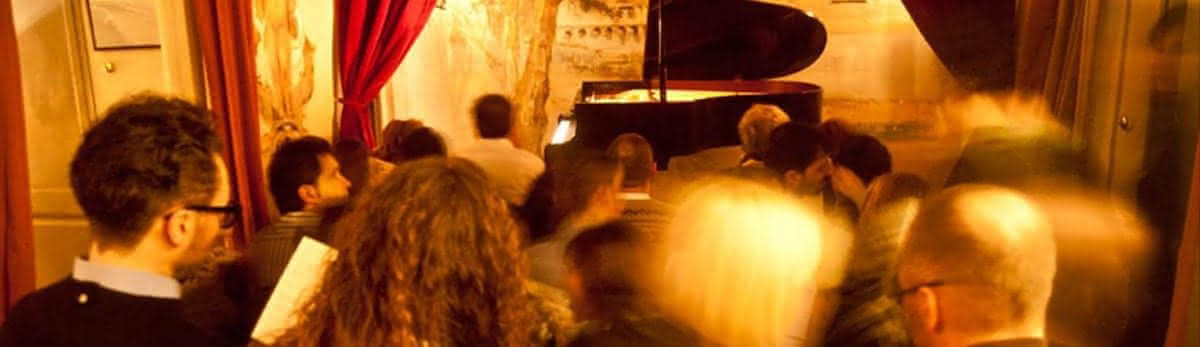
'Only Piano' is the exquisite musical event offered every Saturday evening at 'The World's Smallest Theater' in Barcelona.
The concert pianist, master of improvisation, and award‐nominated film composer Luis de Arquer describes these exclusive and intimate concerts as inventive and satisfying. Set within Arquer's own home, the World's Smallest Theater (El Teatre més Petits del Món) offers nineteenth‐century ambience that perfectly suits the music of Chopin, Beethoven, and Mozart, as well as the Arquer's own compositions and improvisations.
The evening ends with the luxurious pleasure of a glass of champagne in the romantic candlelit garden.
Even the most demanding music lovers will be impressed by this lovely evening, of which the New York Times travel guide wrote, 'This may be your most charming musical evening in Barcelona.'
Artists
| Soloist: | Luis de Arquer Luis de Arquer began his studies in Cerdanyola del Vallés, a small town near Barcelona, coming from a family of great artists and music lovers. During his first lessons, one of Beethoven’s sonatas interpreted by his first teacher, Lolita Martínez, made such a profound impact on him that it was at this moment he decided to dedicate his young life to music. At the tender age of seven, he improvised different styles on the piano, including Bach, Chopin, and Beethoven, captivating the public with his ability and musical imagination. His rapid progress opened the door to the Academia Marshall in Barcelona; a meeting place in the past for the finest musicians of the time. He finished studies with First Prize and special commendation from the Board. Thanks to a scholarship from the Generalitat de Catalunya, he perfected his study technique at L’Ecole Normale de Musique de Paris under Aquiles Delle‐Vigne. |
|---|
Customer Reviews
4.5 of 5
-
Alexandre B., France
Aug 2012
Nous avons passé une excellente soirée. L'accueil était parfait. Les places sont réservées une fois que l'on s'est présenté durant la 1/2 heure qui précède le début du concert. Cela permet d'aller prendre un verre dans les ruelles alentour. La salle est dotée d'une bonne acoustique. Louis de Arquer a passé plusieurs minutes à détailler son interprétation ainsi que ses propres œuvres, dans un Castillan plus que compréhensible. A la fin du concert succède la dégustation d'un cava dans le patio de l'arrière cour — endroit très agréable, légèrement éclairé. Louis, comme osent l'appeler tous les gens présents, va alors de groupe en groupe, discuter avec son auditoire. Il nous a, avec émotion, dédicacé un de ses CD (gagné quelques minutes plus tôt) aux cours des mots que nous avons échangé en Français.
-
Kerstin K., Germany
Jul 2012
it is a very individual atmosphere and if you are a fan of feeling the music this is the right place
-
Sergio G., Spain
Feb 2012
It was one of the best piano recitals I have ever been! I am very thankful with you, because I bought this ticket on December and because of work issues I could t go to the event, and you gave me a 70% refund, and this make that I could bought the two tickets again for this time.
-
EVA P., Spain
Dec 2011
Fue una total sorpresa, pues no teniamos conocimiento ni del local ni del pianista. El local es realmente original y muy acogedor, es la misma casa donde reside el pianista, el cual me pareció extraordinario, con muchísima fuerza. Para terminar nos ofrecieron una copa de capa en el jardin y pudimos hablar con el pianista, el cual es una persona muy agradable y un gran conversador. Un 10 en todo. Repetiremos y lo recomendaremos.
Address
El Teatre més Petit del Món, Carrer de l'Encarnació, 25, Barcelona, Spain — Google Maps